
Introduction
With over six billion smartphone users worldwide, the mobile app industry continues to expand rapidly. Forecasts suggest that by 2030, the global mobile app economy will exceed a market value of $626 billion. In 2024, many developers achieved significant financial success, with numerous apps generating over $1 million in gross revenue on the App Store.
If you are eager to join this thriving industry, it is essential to stay up-to-date with the latest technologies and trends shaping mobile app development today. This article provides an in-depth examination of the primary approaches for building mobile apps in 2025, enabling developers and businesses to make informed decisions.
The Evolution of Mobile App Development
A decade ago, mobile app development was relatively straightforward. Developers primarily chose between native apps built separately for iOS or Android, or hybrid frameworks like Ionic and Cordova that converted web applications into mobile-friendly formats. Other platforms such as Xamarin and Windows Phone have largely disappeared.
Today, the ecosystem is far more diverse. Developers must choose from multiple mature technologies, each with distinct strengths and trade-offs. While this flexibility is powerful, it also makes decision-making more complex.
Native Mobile App Development
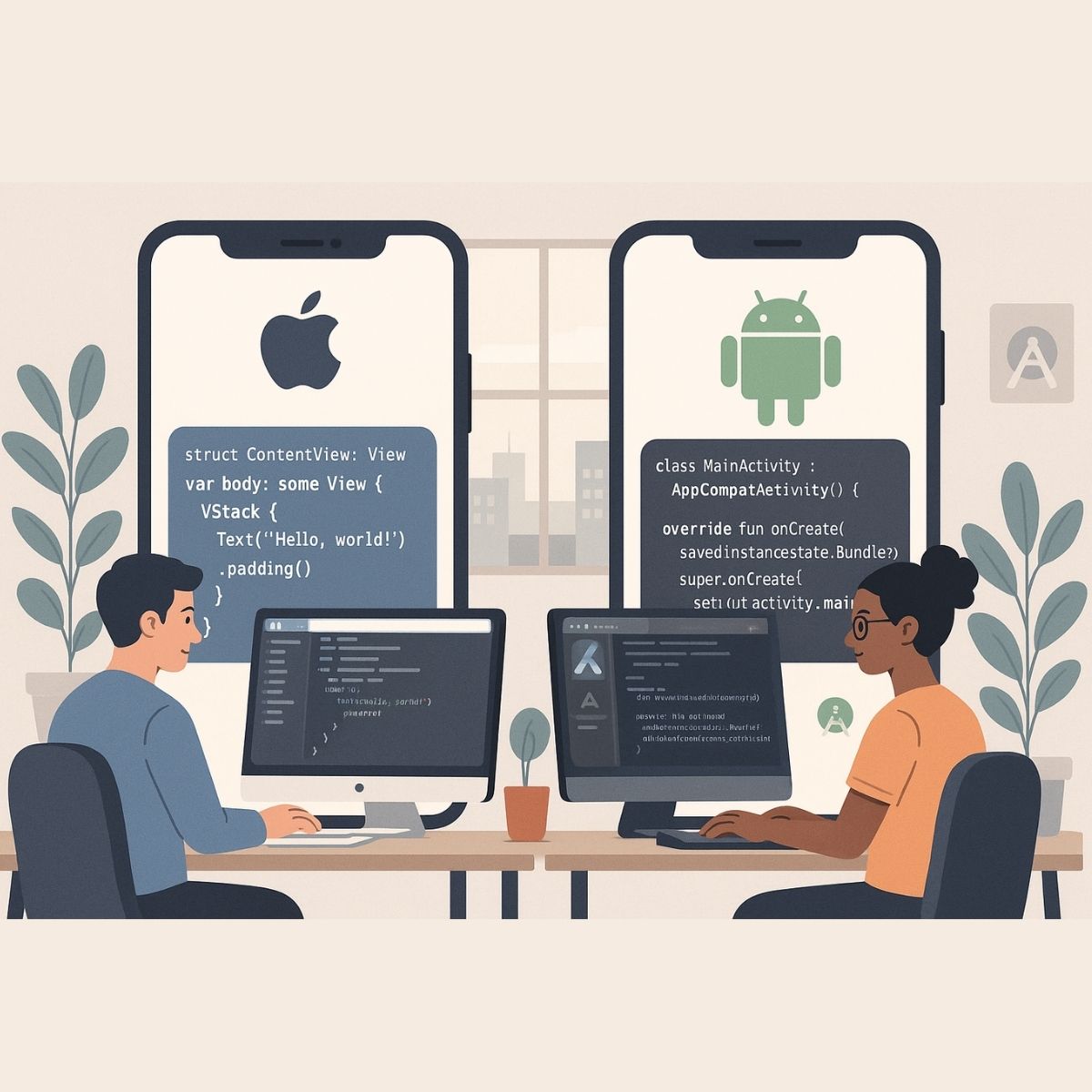
Native development remains the gold standard for performance and user experience. Applications are built using official languages and tools provided by Apple and Google, enabling deep integration with platform-specific capabilities.

iOS Native Development
Apple’s Swift language has become the primary choice for iOS app development, replacing Objective-C. SwiftUI, a declarative UI framework, simplifies interface creation and accelerates development. However, native iOS development requires macOS and Xcode, which remains essential despite stability concerns.
Android Native Development
Kotlin is now the preferred language for Android development, offering null safety, coroutines, and cleaner syntax compared to Java. Jetpack Compose replaces XML-based layouts with a declarative UI approach, while Android Studio provides comprehensive tooling for testing and debugging.
While native apps deliver optimal performance and full hardware access, maintaining separate codebases for iOS and Android increases development costs and timelines.
Cross-Platform Development
Cross-platform frameworks allow developers to build applications using a single codebase that runs across multiple platforms, significantly reducing development time and cost.
React Native
React Native enables mobile app development using JavaScript and React. It renders native UI components, providing a platform-authentic experience. Tools like Expo simplify development and cloud-based iOS builds, though custom native integrations may be limited.
Flutter
Flutter uses the Dart language and renders UI through its own graphics engine rather than native components. This allows highly consistent and customizable interfaces across platforms. Flutter is praised for fast performance and strong documentation.
Kotlin Multiplatform
Kotlin Multiplatform focuses on sharing business logic while keeping native UI development intact. Developers write shared Kotlin code for data and networking while using SwiftUI and Jetpack Compose for platform-specific interfaces.

Emerging Trends Shaping Mobile Apps in 2025

- Hyper-Personalised AI Companions providing adaptive and contextual user experiences
- 6G Connectivity enabling ultra-fast, low-latency applications
- Decentralised Applications (DApps) leveraging blockchain technology
- Digital Twin applications for simulation and predictive analytics
- Mixed Reality Commerce through AR and VR experiences

- IoT Integration for controlling connected devices

- Touchless and Alternative User Interfaces such as voice and gesture control
- Progressive Web Apps (PWAs) combining web reach with app-like performance
- Green Coding practices focused on sustainability

- Quantum-Resilient Encryption to protect data against future threats
Choosing the Right Technology
Selecting the right mobile app technology depends on performance requirements, budget, timeline, and target audience. Native development is ideal for high-performance applications, while cross-platform frameworks offer faster development and broader reach.
For developers, mastering both native and cross-platform tools expands career opportunities. JavaScript developers can explore React Native, while Kotlin developers benefit from Kotlin Multiplatform’s hybrid approach.
Conclusion
Building scalable and future-ready mobile applications requires the right blend of technology, expertise, and vision. At Jiffy, we specialise in delivering custom mobile solutions aligned with modern trends and business goals.
For consultations or app development inquiries, contact us at info@jiffysoftwares.org. Let’s build the future together.
